
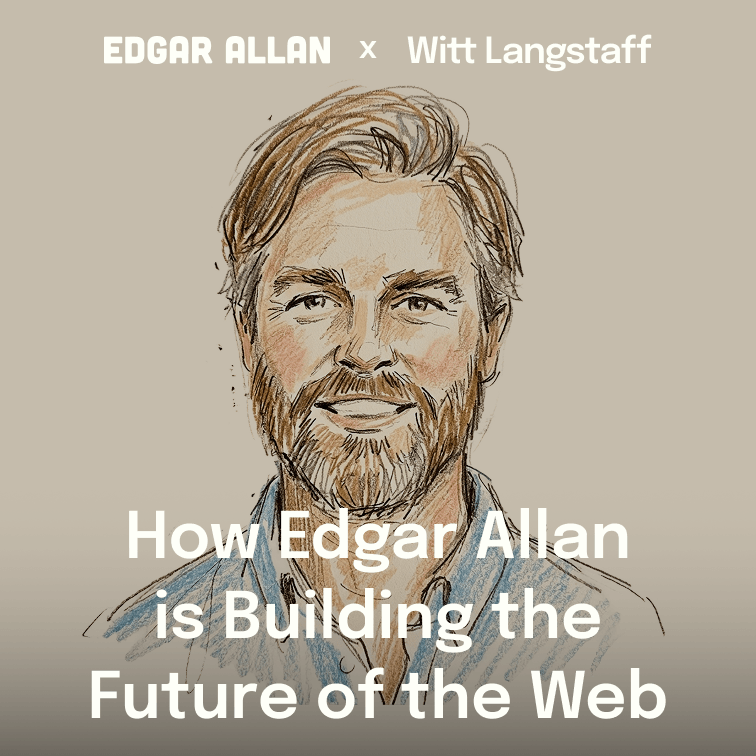
A Good Time to Be Curious: How Edgar Allan is Building the Future of the Web

TL;DR
- Using a reverse proxy manager Edgar Allan’s Witt Langstaff built, we turned a six-month migration into a weekly deployment cadence, with far less QA overhead each time. The project is now up for an AI Achievement of the Year.
- Webflow Cloud provides one connected environment, so clients can stop maintaining a separate Cloudflare account on top of Webflow. That means just one login, one bill, and no second vendor to manage.
- Even as agents build and write code and get more advanced, Witt argues the job still needs someone who knows what the code is supposed to do: "one of the biggest skills with so much of this stuff is just being a good writer."
1-800-GOT-JUNK? was supposed to take two deployments over five to six months. They had a pile of Drupal pages moving to Webflow, three separate collections that needed to look like one clean URL structure to visitors, and a checklist of URL requirements specific enough to make most migrations grind to a halt. Witt Langstaff, Solutions Architect and AI / Tech Lead at Edgar Allan, built a reverse proxy manager to handle the rewrites, then built a testing dashboard on top of it because he wanted a better way to show the client what was happening behind the scenes. Rather than taking months, the migration shipped weekly with minimal QA headaches.
In a recent episode of Building the Next Web, I sat down to chat with Witt to go over some of the amazing things he’s been building, from client work to Edgar Allan’s own website, built to figure out what a conversational, AI-native web actually looks like.
Our conversation covered all things tech and the trajectory of AI, and what its rapid advancement means for our industry.
What does Webflow Cloud replace?
Webflow Cloud is Cloudflare Workers running inside an environment that's already connected to your Webflow designer. For a client, that's the difference between managing one account and managing two.
When Webflow Cloud launched, our team recognized its value immediately: it offers the same server-side capability, minus the second vendor relationship. So no one now has to manage a separate Cloudflare account alongside their platform.
Webflow Cloud gives developers three infrastructure pieces to build with: D1 databases for persistent storage, KV stores for fast key-value lookups, and R2 object storage for images, PDFs, and files. Put those together, and as Witt says, "you could build a full site in Webflow Cloud."
Three ways Edgar Allan uses Webflow Cloud for clients
- Search sync: We’ve built an internal product at Edgar Allan called Slater Search that keeps a client's Webflow content in sync with search services like Algolia, triggered on webhooks or GitHub Actions. Data gets pulled, cleaned up, and pushed through automatically instead of drifting out of date.
- AI middleware: Webflow Cloud handles the connective layer between a Webflow site and OpenAI, Anthropic, or a local model, without standing up a separate server. "It just kinda handles that layer," Langstaff says.
- Form and CRM routing. For clients who need a Zapier or Make replacement, Webflow Cloud can intercept a native form submission, validate it against a platform like Salesforce or Creatio, transform the data, and route it, while the native Webflow form still fires. The client keeps their email notifications and their fallback record even if the external system fails.
The tools nobody asked for that are changing our internal landscape
The activity log analyzer started as a one-off. We needed more granular visibility into a client's Webflow activity feed than the native version surfaced, so Witt built us a tool that filters by date range, user, edit type, and specific collections. "We needed it to narrow down something when we were trying to diagnose a bug." Now it's how the team gets, in Witt’s words, "a ten thousand- foot view and then can zero in on specific stuff."
The reverse proxy manager for 1-800-GOT-JUNK is another example. Three Drupal collections, three different folder slugs, one required URL structure. Witt built the rewrites and a dashboard that shows whether a given URL routes to Webflow or Drupal, what the consolidated slug looks like, and how the SEO rewrite behaves in real time.
And so, a migration that was supposed to take two big deployments turned into a weekly cadence, and the dashboard is why the client could see and trust every one of the pushes.
What Edgar Allan learned building our own AI search experiment
Two years ago, we started asking a harder question: what happens to a website once AI chatbots are answering people's questions directly, before they ever click through to find the answer on a website? We built our answer straight into edgarallan.com: a conversational interface where a visitor can type a real question and get a direct answer, instead of hunting through pages to find the information they’re looking for.
Every question-and-answer pair we wanted the site to be able to handle lives in a KV store as a confirmed reference set. When a visitor asks something, the system matches the intent behind the question against that confirmed set, returns the closest match, then generates a natural transition around it.
The system only generates answers from a confirmed set of responses, matched to a visitor's intent rather than generated freely. That's what closes off the prompt injection risk that comes with open-ended AI replies.
That constraint was deliberate. Open-ended AI responses are gullible: ask them the right way, and they'll hand over something they shouldn't. By turning "intent into content," we built a system that can't be talked into a bad answer, because matching a confirmed response to a visitor's intent was the whole mechanism from the start. (We’re glad we did it this way. Within days, people were asking the site to give them everything from its own codebase to the agency’s financials. Humans are wild.)
The same logic is in our hypothesis on where AEO is moving. Search used to reward keyword matching. It now rewards being the source an AI system trusts enough to cite, or the one a third party explains clearly enough to quote. That shift from keywords to intent is most of what Edgar Allan’s AEO audit process is built to diagnose, and it's the throughline of our Visibility Engineering and Optimization methodology: brand clarity plus site architecture and AI visibility, treated as one problem instead of three separate ones.
"We can't exactly track what people are putting into these models and other places. But what we can understand is what they're putting into our website." This conversational interface turned our site into owned media, a place where we could track our consumers’ behavior to understand what it was they wanted to know. Now, we’re building that same analytics layer into Slater Search directly, alongside AI mode, filtering, sorting, and pagination.
From our own site to Satellite Industries: Turning questions into real search queries
That same approach, intent over generation, is what we build into client search too.
One of our clients, Satellite Industries, makes portable trailers for events, the kind you've stood in line for at a wedding without thinking twice about who manufactured it. We built natural language search for their site: so if someone types "tell me about SaniTrax" or "what trailers do you offer," the system can interpret the question, figure out the product or category being asked about, and convert it into a structured query against Slater Search or Algolia.
The AI acts here, in Witt’s words, as "an interpreter rather than a generator," inferring the connection between what someone asks and what content answers it. That's a smaller, cheaper job than generating an answer from scratch, and it's more reliable for exactly that reason. We are at the flip-phone stage of AI-enabled personalization: there's still so much to come for the industry, which is exciting and means ideas like this are tangible and encouraged. Search that understands plain language instead of requiring the right keywords is an early, working version of what that looks like at scale.
Why agents still need a good writer in the room
Agents extend what Witt has built for Edgar Allan and our clients, but they don't replace the part of a very human job that matters a whole lot. He still checks the input, checks the output, and checks that the database calls are doing what they're supposed to. The reality is, AI agents can assist with the work, but owning it end-to-end is still a living person’s job.
"It's almost like you're a creative director for a code build. It's knowing that you've got this tool that can help you create whatever, and then making sure that you're still in the driver's seat, saying, "this is what I need, this is what I want."
Ask him how anyone should keep up with a field moving this fast, and he doesn't pretend it's even possible. The line we kept coming back to during our conversation is the one that should sit above a lot of AI strategy decks right now, and is simpler than any framework: "One of the biggest skills with so much of this stuff is just being a good writer."
That's the real constraint underneath all of Witt’s technical work. An agent that writes clean code and a system that answers questions accurately both depend on someone upstream who can define, precisely, what the right answer looks like. Webflow Cloud, local models, and a growing stack of agents make it faster to build almost anything. None of it decides what's worth building, or explains it back to a client, or knows when the answer is wrong. That's still a person's job.
It really is a good time to be curious. The question worth sitting with is what you'd build to solve a problem that's actually yours, and whether you've got the patience to follow the thread that far. If you want to see what that looks like for your own site, contact us to discuss our emerging AI products and how they can benefit your business.
FAQs
What is Webflow Cloud, and how is it different from using Cloudflare Workers directly?
Webflow Cloud runs on the same underlying infrastructure as Cloudflare, but it lives inside your existing Webflow environment instead of a separate account. That means one login, one bill, and direct access to your Webflow designer and content, rather than maintaining a second vendor relationship alongside Webflow.
Can Webflow Cloud replace tools like Zapier or Make for form processing?
For many use cases, yes. Webflow Cloud can intercept a native form submission, validate it against an external system's requirements, transform the data, and route it, all while your original Webflow form still submits normally. That gives you the automation of a third-party tool with a built-in fallback if the external system is ever unavailable.
Does adding AI search or a chatbot to a Webflow site require a separate server?
In short, no. Webflow Cloud is designed to serve as the middleware layer between a Webflow site and an AI service like OpenAI, Anthropic, or a locally hosted model. It handles that connection directly, which is one of the more common reasons why Edgar Allan reaches for it on client projects.
What's the difference between optimizing for search engines and optimizing for AI answer engines?
Traditional SEO rewards matching the keywords someone typed. AEO rewards being the source an AI system trusts enough to cite or summarize accurately, which depends more on how clearly your content states intent and expertise than on keyword density. Edgar Allan's AEO audit process is built specifically to diagnose that gap.
Do you need a developer to build on Webflow Cloud, or can a marketing team manage it?
Building the underlying tools generally still requires development skill, but the day-to-day content and configuration can stay inside a marketing team's hands, since Webflow Cloud is built to extend the existing Webflow designer rather than replace it.
How does Edgar Allan use its own website to understand what customers actually want?
Our site runs a conversational search layer that only answers from a confirmed set of responses. Tracking what visitors ask for, and what they search for through Slater Search, gives us a direct read on customer intent that external platforms like ChatGPT can't provide.
Has Edgar Allan handled large, complex enterprise migrations before?
Yes, including migrations that go well beyond a simple platform swap. Moving 1-800-GOT-JUNK from Drupal to Webflow meant consolidating three separate collections, each with its own URL structure, into one clean structure without breaking the client's SEO or workflow.
Our senior developer built a custom reverse proxy manager and a real-time testing dashboard specifically for that migration, which turned a project scoped for two deployments over five to six months into a weekly deployment cadence, and that build is now up for an AI Achievement of the Year award. It's a good example of how we approach enterprise migrations: when a platform's native tools hit a limit, we build the custom tooling to close the gap rather than work around it.