
What Stu Ross and I Agree on About AI, Webflow, and Growth

- The vibe-coded prototypes clients bring into enterprise pitches are almost always bloated, but the prompts behind them reveal more about what a client wants than the exported code does.
- A stakeholder judging a wireframe as if it were a finished design is the most common reason creative approvals stall, more often than genuine creative disagreement.
- Awards and platform bets are great at buying visibility, but referrals from clients who’ve gotten real results are the real, sustaining win.
We put two agency founders who've adopted AI aggressively on a LinkedIn Live, and learned that neither one has cut a single role because of it. That's the sharpest thing to come out of a conversation Stu Ross of OFF+BRAND and I had recently, one that was supposed to cover one topic and ended up covering six, all pointing the same direction. It's part of the same series that included our talk with Anthropic's Corey Moen.
Stu built OFF+BRAND on experiential, awards-driven work. I built Edgar Allan on brand strategy and enterprise Webflow, two different starting points that kept landing on the same conclusions. Almost everything we compared notes on, AI, pitches, approvals, hiring, growth, landed in the same place. The clearest agreement, and the one everything else kept circling back to, was about AI itself.
AI clears out the drudgery so judgment can do the real work
Stu put the OFF+BRAND version of this plainly: the studio has more developers and designers on staff now than before it adopted AI, and it hasn't cut a role since. What changed is how people spend their time. AI absorbs repetitive work so the team can focus on storytelling, stakeholder management, and the interaction design that makes a site memorable. It's the same shift reflected in our article about how AI systems are changing what brands need from their websites.
My version shows up in the parts of the business that never generated client value in the first place: documentation, first drafts, repetitive builds. We run project retros through AI now instead of spending hours writing summaries by hand, but that's the smallest example.
We also built a Figma commenting tool with AI that helps our design team sort through stakeholder feedback faster. In addition, we use AI to get a working first draft of a proposal in minutes instead of hours, so we can spend time on the argument that's specific to that client, not the boilerplate around it. And this blog runs through its own set of AI-assisted guardrails, so the different writers on our team can't accidentally drift into different voices.
The tooling is how we get to the point faster. We chose Webflow originally so we could work directly in the finished medium instead of producing endless documentation about what the finished medium should look like. AI does the same job one level up: it clears out the busywork so the people doing the actual work can spend their time on judgment, not process. We call this wisdom work: the work that requires taste, context, and a stake in the outcome, the parts of the job a model can't do for you.
A vibe-coded pitch works best as free research
The same instinct about where AI belongs, and where it doesn't, showed up again when Stu described what a pitch looks like now. OFF+BRAND increasingly gets pitches where a prospective client, sometimes a technical founder or CTO, shows up with something already built in a tool like Claude Code. The result is almost always bloated, but the prompt that produced it is usually more useful than the code, since it reveals what the client wants more clearly than the export does.
For small projects, Stu said AI output can be the whole job. Ross, OFF+BRAND's co-founder, vibe-coded Stu's wedding website on a flight to the U.S. Enterprise work is different. It rarely survives contact with real requirements around scale, maintainability, and brand consistency, so OFF+BRAND treats a client's rough AI attempt as free research: a mood board that shows exactly what the client is trying to say.
A prompt that produces a bloated prototype often reveals more about what a client wants than the code it exports.
Awards and platform bets buy visibility
Visibility turned out to be another place Stu and I both made the same bet, just from different directions. Stu's relationship with Webflow stayed practical: OFF+BRAND builds roughly half its projects there and the rest on other platforms, largely driven by whatever stack a client's technical leadership has already committed to.
My path started years earlier and further upstream. I found Webflow around 2015 while looking to shorten the distance between a client's idea and something real they could see and use rather than producing rounds of static comps and documentation.
An early video of co-founder Sergie Magdalin talking candidly about Webflow's rejection from Y Combinator, the startup accelerator that funds early-stage companies like Airbnb and Stripe, helped convince me Webflow was built by people worth growing alongside, so we built Edgar Allan's first site on it. 11 years and a growing stack (React, Cloudflare Workers, Algolia) later, that early bet became our enterprise Webflow practice.
Awards work the same way. OFF+BRAND still self-funds a flagship experiential project most years aimed at shows like Awwwards or Manifesto, a habit that traces back to Totem Earth, the crypto site that won Site of the Day in 2021 and still attracts clients willing to fund ambitious work.
My version has a sharper edge. After Edgar Allan got zero Webflow Conf nominations one year, despite a large volume of enterprise brand and build work, I built a passion project called Letter Run: a fully playable 3D clubhouse and scavenger hunt built purely to prove what was possible in Webflow, no client involved. Nine months later it won Awwwards Site of the Day and Technical Achievement at Webflow Conf, one of three awards we took home that year. The line from those awards to new business was indirect, but the visibility they built inside the community outlasted any single deal they might have won us.
Stu and I treat award season the same way: a controlled investment in being seen by the kind of client who wants ambitious work.
A wireframe reviewed like a finished design is the most common reason creative approvals stall
Stu and I compared notes on a problem neither of us has fully solved: a stakeholder who comments on a wireframe as if it's a finished design, or calls a sitemap underwhelming. Stu said it happens on almost every project OFF+BRAND runs, regardless of client size or industry.
At Edgar Allan, we built a stakeholder feedback guide for exactly this reason: a short document that tells stakeholders what they're reviewing at each stage and what kind of input is useful there. It shortens the number of rounds spent clarifying what stage of the process a document represents.
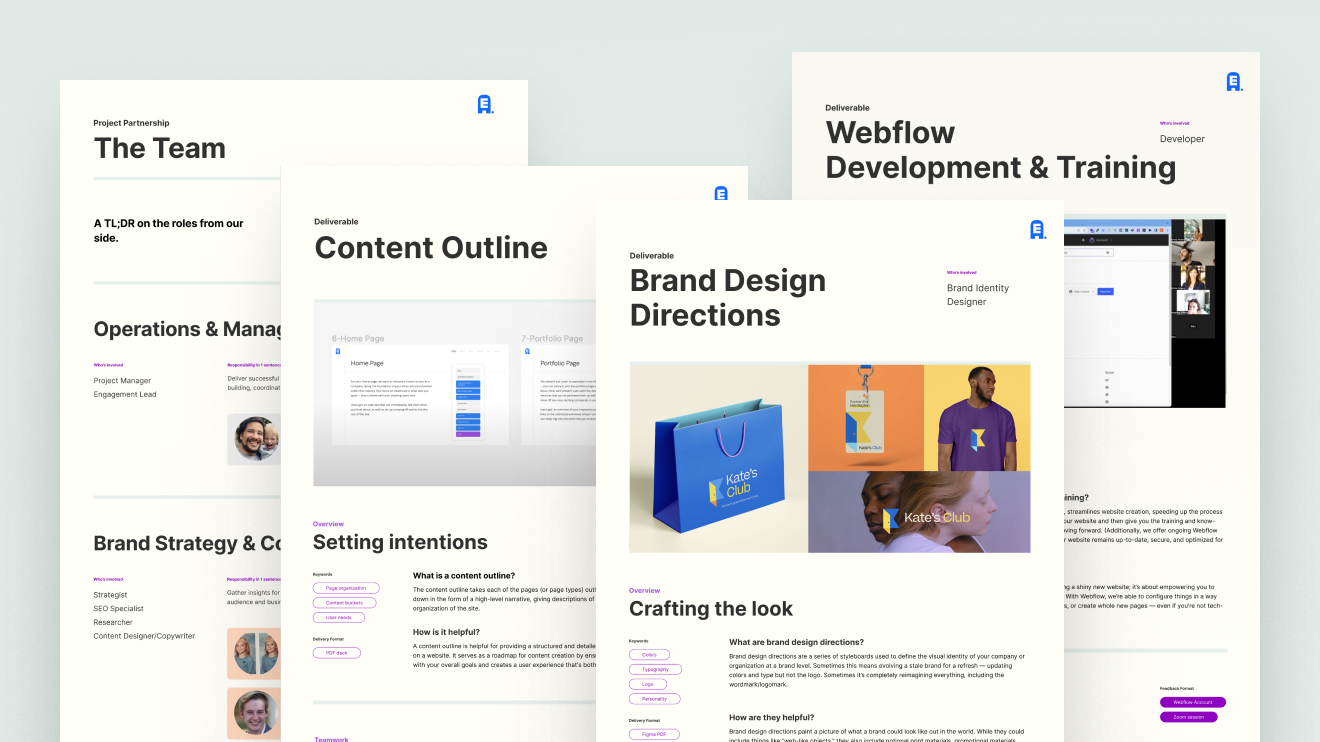
A stakeholder judging a wireframe as if it were a finished design is the most common reason creative approvals stall, more often than genuine creative disagreement.
For experiential, high-stakes projects like OFF+BRAND's Microsoft Windows build, Stu said the fix starts even earlier: getting explicit sign-off on the central strategic message, the red thread, from the real decision-maker before any design work begins. It's a term strategists use across the industry, not something unique to OFF+BRAND, and it's the same one I rely on when running Edgar Allan's own approval process. Skip that step, and the real decision-maker tends to surface weeks in with objections that should have been resolved on day one.
The trait Stu hires for: letting go of good ideas
Stu said the thing he screens for most carefully in designers and strategists is the willingness to abandon a good idea the moment a client rejects it. The stronger move is playing a client's feedback back to them, confirming what they meant, and moving forward without defensiveness, since reintroducing a rejected idea, however strong it is, just reads as not listening.
I've watched this play out on both sides of the table. On a project we ran together, Stu started defending an idea in front of the client, and I cut him off mid-sentence. He brought it up on the call, generously, as an example of the discipline in action.
Knowing whether to guide a client back to an idea they already approved, or let a favorite idea die without ceremony, is the judgment call every account lead has to make. That judgment call is what keeps ambitious work moving without spending down the client trust it took to earn a seat at the table.
Referrals are the growth engine that sustains an agency
The conversation ended on the place both of us kept coming back to: what grows an agency.
I've kept Edgar Allan expanding at roughly 15-20% a year, on purpose, and most of that growth traces back to referrals, not chasing new logos. Clients who get real results tend to send us the next client, or expand the work they're already doing with us, which is exactly what our Customer Success Program (CSP) is built for: an ongoing, flexible way to keep working together instead of starting a new engagement from scratch every time.
That discipline also means building in a buffer for slow stretches. Some months are brutal regardless of how healthy the pipeline looks, and we rebuild the plan for the year each January based on where the business stands, not where we hoped it would be.
Stu and I landed on the same closing point from different angles. Awards and platform bets are excellent at getting an agency noticed. Referrals from clients who got real results are what keep the lights on long after the visibility fades. Any team building a growth plan around AI, a platform, or a portfolio strategy should be honest about which one they're optimizing for.
The full conversation with Stu covers more than fits here, including his breakdown of how OFF+BRAND ran the Microsoft Windows project and what he screens for when hiring designers. Watch the full recording to hear all of it, and follow Edgar Allan on LinkedIn if you want to catch the next conversation in this series live.
FAQs
Does using AI tools reduce the need for a web design team?
No agency in this conversation cut headcount after adopting AI. OFF+BRAND has more designers and developers on staff now than before it started using AI tools, and Edgar Allan uses AI to speed up internal work like retro documentation, proposal drafts, and design feedback rather than shrink client-facing teams. Both agencies point to the same shift: AI absorbed the repetitive work, and the time it freed up went into strategy, storytelling, and stakeholder management, the parts of the job that were always harder to automate. The lesson holds for any agency: AI should buy back time for judgment.
Why do vibe-coded prototypes often fail when handed to a professional agency?
They tend to be bloated and built without the architecture an enterprise site needs to scale, stay maintainable, and hold a brand consistent across pages. Stu Ross of OFF+BRAND said the prompt a client used to generate a prototype is usually more useful than the resulting code, since it reveals what the client is trying to communicate. For small projects or personal sites, that AI-generated output can be the entire job. Ross, OFF+BRAND's co-founder, used the same approach to vibe-code Stu's wedding website on a flight. Enterprise work rarely survives contact with real requirements, so OFF+BRAND treats a client's rough AI attempt as free research: a mood board that shows the intended direction, which the studio then builds into something real.
Why did Edgar Allan choose Webflow as its core platform?
We started building on Webflow around 2015, looking for a shorter distance between a client's idea and something real they could see and use, rather than another round of static comps and documentation. Webflow offered a visual abstraction layer that still gave us the real primitives underneath, a level of depth most no-code tools skip. Watching an early video of co-founder Sergie Magdalin talk candidly about Webflow's rejection from Y Combinator, the startup accelerator that funds early-stage companies like Airbnb and Stripe, helped convince us the platform was built by people worth growing alongside. Edgar Allan's first company website became the start of our enterprise Webflow practice, and we've added React, Cloudflare Workers, and Algolia to the stack over eleven years as client needs got more complex.
How does Edgar Allan approach sustainable agency growth?
We target roughly 15-20% growth year over year, on purpose, and most of that growth comes from referrals and from expanding work with clients we already have, often through our Customer Success Program, rather than aggressive new-business chasing. That pace leaves room for a financial buffer during slow months, which happen regardless of how healthy the pipeline looks. We rebuild the annual plan every January based on where the business stands rather than where we hoped it would be.
What drives new business for agencies like Edgar Allan and OFF+BRAND?
Referrals from clients who got real results. Awards and visible, ambitious projects build awareness, and both agencies invest in them deliberately. But the relationships that actually sustain the business come from clients willing to tell the next client what the work did for them. Any agency building a growth plan around a platform, an award strategy, or an AI tool should be honest about which of those is generating pipeline, and which one is just getting them noticed.