
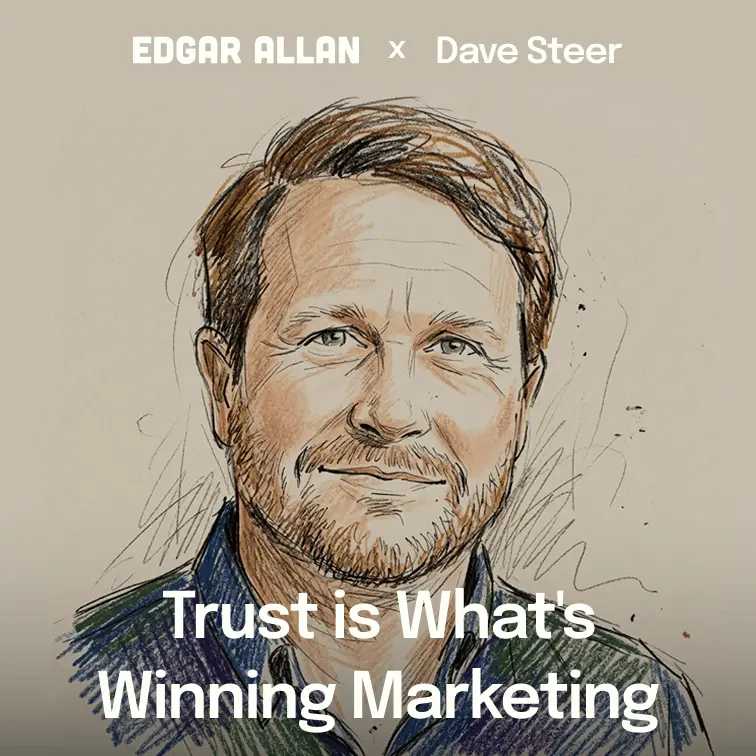
Trust Is What's Winning Marketing Right Now: Navigating The New Web Landscape with Dave Steer

TL;DR
- The hardest part of web marketing has shifted from getting a site live to what happens on day two and beyond.
- Trust now functions as a measurable asset, not a feeling: brands that track it through sales-call sentiment, social listening, and recurring health surveys catch problems long before a prospect, or an AI system, notices them first.
- Answer engine optimization is forcing marketing teams to break down the functional silos they spent two decades building, encouraging cross-channel strategy and planning, as AEO only works as a team sport.
If there’s one statement to take away from my conversation with Dave Steer, it’s that “trust is an operating model, not just a value statement.”
Dave Steer has run marketing for a consumer platform, two infrastructure companies, and now Webflow, and every time I asked him about a different chapter of his career, the same word kept coming up: trust.
Reminiscing on his career at eBay in the late 90s, we mused over how trust was the key thing that built confidence for total strangers handing over credit card numbers to a website with no track record. That's the thread Dave’s carried through his career, and now into Webflow's strategy around what he calls the "living web," sites built to keep adapting instead of sitting still after launch.
This conversation was part of Edgar Allan’s ongoing Building the Next Web series, which has included discussions with our own Jared Malan, Webflow’s Nathan Huening, Finsweet’s Jesse Nieman, OFF+BRAND’s Stu Ross, and more.
The marketer's job hasn't changed in 20 years, only the terrain around it
As the marketing landscape has shifted, ironically, the job of the marketer hasn’t. Dave was blunt with me about this: “The job of the marketer 20 years ago is the same job that we have today. It’s the same job that we’ll have in the next 20 years. And that job is to build a brand that people trust and drive growth.”
While marketing is now pivoting to put AI at the center of the conversation, everyone is asking how we change our marketing strategies to suit what comes next. Our goals are the same; all that’s different is the terrain, and how we learn to climb it.
CMS platforms are under pressure to prove they're AI-native instead of just claiming it. AI search is emerging as a category next to, but distinct from, traditional SEO. And marketing leaders are now tasked with a fourth skill on top of brand, pipeline, and storytelling: leading a team through transformation, without a clear playbook to follow.
Brand, pipeline, and storytelling aren't enough without leadership
A lot of the narrative we’re seeing in-market right now is based around technology. How to utilize AI in your marketing strategy, what to automate and why: but no one’s talking about the transformation that comes for your team when technology takes center stage.
Dave and I talked in-depth about what it means to be a marketing leader in 2026 and beyond:
- Storytelling: being able to intertwine your brand's story with leading marketing and technology strategy to develop trust and relationships with your audience.
- Driving pipeline: converting awareness and interest into actionable growth that shows up in sales and dollars through supporting your sales team.
- Transformation: creating actions and ideas to support your teams as the market changes, especially with the current focus on AI search.
- Leadership: being able to build great, high-performing teams and leading them when the playbook isn’t necessarily clear.
Getting those fundamentals right (which, in reality, can be difficult in itself) gives your team a foundation that can evolve as the whims and trends of the market do. And that’s the real job now: being able to pivot meaningfully, not just chase the next shiny object.
AEO broke marketing's silos whether teams were ready or not
The marketing industry spent two decades building deep, specialized functions: demand gen, product marketing, brand, analytics. Dave calls the result a “relay race,” where an idea has to pass through every silo before it reaches the market. But he told me that Answer Engine Optimization doesn’t tolerate that handoff.
"To win in answer engine optimization, to win in AI search, it's a team sport. You can't operate in a silo."
Brand, content, technical SEO, social, and every other digital channel now have to move together as one, because an AI system deciding whether to cite a brand is pulling signals from all channels, all at once. If your teams are still running the relay-race model, you’re optimizing for a version of search that's already outdated. Getting your team in one room, working towards one collective goal instead of siloed targets, is what moves the needle in this AI-focused era, and this gap is what an integrated brand, AEO, SEO and CRO program is built to solve.
Trust is something that can be tracked
Trust is more often than not talked about in the abstract with most marketing leaders, but after talking with Dave, I realized how important it is to not only monitor these metrics, but measure them.
Dave has his team send him two to three Gong sales calls a week, hand-picked by colleagues he trusts rather than sampled at random, then runs an AI pull on message penetration, objections, and competitor mentions. He uses Sprout Social to track sentiment across Reddit and other public channels his internal tools can't reach, the same instinct behind our own brand clarity assessment: you can't manage a perception problem you haven't measured. This is an excellent way to judge how consumers view the brand, and what problems are arising that you can set your team to solve.
The most unglamorous and often deemed unnecessary of the group, and the operation that most teams quietly stop running, is the quarterly brand health survey. However, this still sees immeasurable value that Dave continues to run, because real, honest feedback grows the trust bank account.
We talked about Dave’s eBay days, and his “trust barometer.” The lessons of the 90’s still have a huge impact on today’s marketing world. In a time when online shopping was relatively new and entering your card details on the internet seemed wholly foreign, Dave built a homegrown consumer-confidence index that enabled him to see how the brand was perceived. Trust became the business’s leading success factor.
These steps are specific, repeatable, and foundational for teams in the AI-era, which is what makes trust a number worth monitoring, instead of a feeling that cannot be identified by performance.
The brief is the one thing worth protecting from automation
One thing’s clear: the brief is one thing that automation should have no say on. Dave made a hugely valuable point that I will be passing on to my own team internally:
"If you abdicate insight to an AI, then that's the same insight that your competitors have. And so they're gonna arrive at the same place."
Dave’s prescription is specific:
- Spend real time upfront on the brief, since that's where a marketer's actual understanding of the project, market, and audience shows up.
- Produce at least one piece of content that's genuinely bespoke based on the original brief.
- Then, let AI take the mundane work from there: resizing ads, cutting one asset into five social formats, the tasks with no strategic upside.
A brief runs on listening and curiosity that can't be faked, on the discipline to keep asking why until something true surfaces, and on aligning that insight with other people before it gets into the hands of the recipient. That alignment step is why the brief works as a document, not just an idea in someone's head. It's how a team gets a shared shot at the truth instead of settling for one person's version of it.
The most AEO-ready brief is the one artifact in modern marketing an AI system can't produce on its own, because writing it well requires knowing something true about a specific audience that no training data captured.
This is the one place I'd push back on automation entirely: a bespoke, human-written brief is going to shape the outcome of a project more than almost anything else.
Agencies have the edge in a market with no playbook
No one has a playbook for AI right now. And if you’re scrolling through LinkedIn and you see people telling you they have the answer: they don’t. The people who are authentic are sharing what worked for them, what’s broken, and what they’re trying next. Those are the people or brands to lean into, because they’re being honest about how much they’re still figuring out.
I asked Dave about agencies, partly with an agenda, since I run one myself. He didn’t hedge: "Agencies have superpowers in this age. Every in-house team is trying to solve it by just looking inside. But you can pattern match across dozens and dozens and dozens of customers and clients that you work with about what works and what doesn't work."
Nobody has a finished AI-marketing playbook yet, which means the advantage sits with whoever has seen the pattern before, not whoever has the biggest internal team.
We work from the same premise at Edgar Allan. Before a client asks whether their brand is correctly described in AI search, we run it through Profound to see what the answer engines are saying, not what we assume they're saying. That's the whole premise behind Visibility Engineering and Optimization: catching the distance between what a brand believes it's communicating and what a prospect's AI assistant is telling them, before that gap costs the brand a deal.
Webflow is betting its next chapter on teams that treat day two as the most important part of the job
Webflow Conf is coming to Boston Sept 1-3. This event will have some of the most exciting speakers and leaders in the industry, but also doubles as a preview of what's coming for anyone building on the Webflow platform.
Ethan Mollick, the Wharton professor behind Co-Intelligence, is speaking on what the next three years of AI will bring. Seth Meyers, who might seem like an odd addition, offers amazing insight as one of the few people who have navigated many platform shifts, from SNL to late-night to podcasts.
And what’s next for Webflow? Dave shared that their latest blog posts are "just a hint, just a taste" of the product news coming. As a Webflow partner, I can’t wait to see what’s next for the platform, and how we can incorporate this next stage of development into bettering our client’s performance.
Teams that treat their site as done after launch are going to spend next year catching up to the ones who treat day two as the real job, and that's the crowd Dave is building Webflow's next chapter around. Find out more about attending Webflow Conf.
FAQs
Do I need a website builder or a marketing platform?
If your team's biggest challenge is still getting a site live, a website builder covers that. If the challenge is what happens after launch, keeping the site accurate, current, and visible in AI search as your business changes, you need a platform built for that ongoing work, not a one-time build tool.
How do I know if my brand is losing ground in AI search?
The fastest way to find out is to run your own brand and category through the AI tools your prospects are already using and compare the answer to what you'd want a salesperson to say. Most teams are surprised by what comes back, whether it's an outdated positioning line, a competitor mentioned first, or a description that just misses the point. An AEO audit does this systematically across the queries that matter most to your business, rather than one spot-check at a time.
What should stay human versus get handed to AI in my marketing process?
The brief and at least one piece of genuinely bespoke content should stay human, because that's where real audience insight gets built and where competitors can't easily copy you. Repetitive production work, resizing assets, adapting one piece of content across formats, is safe to automate. The dividing line is whether the task requires judgment about a specific audience or just execution.
How can an agency help with AEO if there's no established playbook yet?
An agency's real advantage right now is pattern recognition across many clients navigating the same shift at once, something no in-house team working from a single data set can build on its own. Every client experiment, what worked, what broke, what a specific AI system responded to, becomes intelligence the agency carries into the next engagement. That cross-client view is what turns trial and error into a real strategy instead of a guess.
How often should we measure brand trust, and with what?
Effective trust measurement mixes a few sources rather than relying on one: sales call sentiment reviewed weekly, social listening tracked continuously, and a brand health survey run quarterly or twice a year at minimum. The specific tools matter less than the discipline of checking consistently instead of only when something goes wrong. Teams that only look at trust after a launch stumbles are always working from a baseline they never measured in the first place.
What's the difference between AEO and traditional SEO?
SEO optimizes for ranking in a list of links a person clicks through. AEO optimizes for being the answer an AI system gives directly, often without the person ever seeing your site. The two overlap on the technical fundamentals but diverge on structure, since AEO rewards content written to be extracted and cited, not just found.