
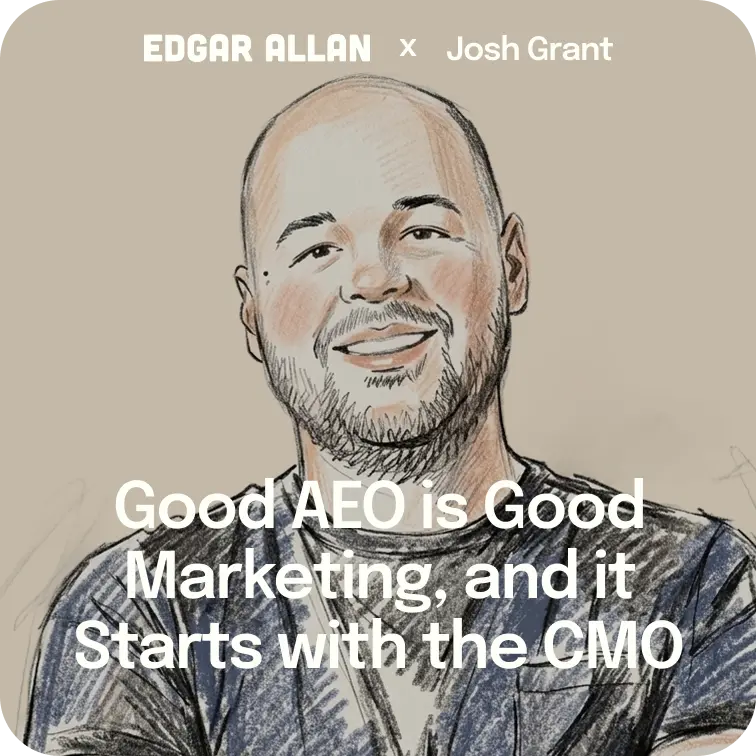
Good AEO is Good Marketing, and it Starts with the CMO

TL;DR
- The most common reason executives blame their SEO team for poor AI visibility is a coordination failure spanning brand, PR, product marketing, and growth, not a technical one.
- Josh Grant, founder of StackedGTM and former VP of Growth at Webflow, told me he believes AEO ownership belongs with the CMO, because AI systems pull signals from every corner of a company's marketing footprint, not just its site.
- A CMO who owns AEO versions the roadmap by marketing function, brand, PR, product marketing, growth, rather than handing the whole thing to whoever runs SEO.
Josh Grant has a blunt answer to who owns AEO inside a company: the CMO. The SEO lead who just inherited an urgent new mandate can't hold the whole picture alone, and neither can a narrow technical fix bolted on from the outside.
Josh is the founder of StackedGTM and spent years running growth at Webflow before that, and he's spent the past year advising companies like Lovable and Profound on how they show up in ChatGPT and Perplexity results.
Recently, I had Josh on for a live conversation about building for the next web as part of our ongoing series that’s included conversations with Ari Yablok from Island, Memberstack’s Julian Galluzzo, OFF+BRAND’s Stu Ross, and more.
The pattern he described during our conversation is one I see constantly with Edgar Allan's clients: AI visibility gaps are usually a brand and coordination problem, not a technical one.
Why the SEO team keeps getting blamed for a marketing problem
Josh told me his clients almost always start the conversation the same way. Something like: we're not showing up in LLM output, so our SEO strategy must be broken. He pushes back immediately. When he builds an AEO roadmap for a client, the resulting plan touches product marketing, PR, community, and growth, and the SEO lead usually ends up owning only a slice of it. He calls it a tiger-team problem: the SEO person can project-manage the roadmap, but they rarely control most of the levers that move it.
The teams struggling with AI visibility that our team sees when running AI brand clarity assessments almost always have a brand that isn't differentiated or consistent enough for a model to describe accurately, not a broken technical foundation, and no single department can fix that alone.
Good AEO is good marketing. A brand that shows up clearly and consistently everywhere a buyer looks, on its site, in PR, on Reddit, in reviews, in how its own customers describe it, gives AI systems a coherent story to cite. Technical SEO cleanup alone can't manufacture that consistency.
What AEO looks like when the CMO owns it
Here's where Josh's point gets specific enough to act on. When he builds a roadmap for a client, he defines it by marketing function rather than by channel. Every initiative gets a named owner across brand, PR, product marketing, content, and growth. The SEO lead might run point on technical execution, but the CMO is the only person in the org sitting above all of those functions at once, which makes them the only one positioned to catch where the brand's story is drifting.
That's the same reasoning behind why we built Visibility Engineering and Optimization as a single methodology instead of four separate service lines. Brand, SEO, AEO, and CRO reporting to four different owners all but guarantees the story fractures somewhere between them. A CMO who treats AEO as one more line item on the SEO team's task list is asking a single function to solve a company-wide consistency problem it was never given the authority to fix.
Attribution is broken, and that’s forcing better discipline
The second thread Josh and I pulled on was measurement. Three years ago, marketers could trace a form fill back to its exact source with a UTM parameter. That clean click path is largely gone. AI-referred traffic is a small slice of what a site receives, and a lot of AEO's impact shows up as improved brand perception long before it shows up as a trackable session.
Josh's answer is to keep proving ROI on the channels that remain measurable, like paid media and parts of technical SEO, and use that credibility to fund the harder-to-attribute work. For AEO specifically, that means getting a baseline on a metric before a change ships, then measuring against that baseline afterward rather than expecting a clean attribution line. Directional data becomes the signal to invest further, not a perfectly traceable dollar amount.
This is the logic behind our Visibility Engineering and Optimization methodology: brand, SEO, AEO, and CRO working as one measurement loop instead of four disconnected reports.
Where brands waste money chasing AI visibility
Josh was direct about where he sees brands wasting money. Reddit spam is still common, built on the belief that flooding a subreddit increases citation share. The same pattern has shown up on YouTube, where brands churn out low-quality videos hoping volume alone earns citations. Neither of these approaches works, and both tend to backfire as detection improves.
Link trading and paid placement on curated "best of" lists are riskier still. Josh expects a lot of burned budget here as AI systems catch up to the same kind of manipulation search engines have spent two decades learning to discount.
What Provv shows me about velocity as a moat
The most concrete part of our conversation was Josh's live demo of Provv, a tool he built to test marketing messages against personas modeled from thousands of public data sources, G2 reviews, Reddit threads, Capterra comparisons, and more. Drop in an ad, a headline, or a landing page, and Provv returns feedback from those modeled personas in under a minute, plus a companion feature called Plays that turns last week's market chatter into a ready-to-run campaign.
Josh built the entire thing himself in about six weeks, using Claude and Lovable, with no engineering team. That's the part I keep coming back to. The barrier to shipping a working product used to be a development team, and now it's mostly curiosity and time. Josh put it well: velocity is the moat right now, and judgment and creativity are what decide whether that velocity is pointed somewhere useful.
That's also the logic behind our Customer Success Program, which exists precisely because most teams need flexible, senior capacity to move at this speed, not another six-month engagement structure built for a slower internet.
If you're still routing every AI-visibility conversation through your SEO team, start by asking who owns your brand's consistency across PR, product marketing, and community. That's where the real roadmap begins.
FAQs
Who should own AEO strategy within a marketing team?
The CMO, in Josh's view, because AEO success depends on signals from across brand, PR, product marketing, and community, not just the website. The CMO is the only role positioned above all of those functions at once, which is what makes them able to catch a drifting brand story before it shows up as a citation problem. SEO teams often end up managing the roadmap day to day, but they rarely control most of the levers that move it.
What does it look like when a CMO owns AEO, in practice?
It means the AEO roadmap gets versioned by marketing function rather than handed entirely to SEO. Brand, PR, product marketing, growth, and content each get a named owner and a specific initiative, with the CMO holding the whole picture together. Companies that skip this step and route AEO exclusively through their SEO function tend to stall, because the real gaps usually sit outside SEO's control. In practice, that means the CMO is reviewing the same roadmap PR and product marketing are working from, not a separate SEO-only version of it.
How do you measure ROI from AEO if attribution is unreliable?
Prove ROI on channels that remain measurable, like paid media, and use that credibility to fund harder-to-attribute work. For AEO specifically, baseline a relevant metric before a change ships, then compare against that baseline afterward instead of expecting a clean, traceable dollar figure. Directional movement, brand mention frequency, sentiment, or citation share, becomes the evidence that justifies further investment. It's a different kind of proof than a UTM-tracked conversion, but it's still proof.
Is Reddit and forum activity still worth investing in for AI visibility?
Yes. Authentic conversation across Reddit and community forums genuinely helps AI systems understand a brand. Spamming those same forums with manufactured posts does not, and increasingly backfires as detection improves. The distinction is authenticity, not volume. A handful of genuine, detailed threads from real users will outperform a hundred manufactured posts every time, because AI systems weigh consistency and specificity over sheer mention count.
How is AEO different from traditional SEO?
Traditional SEO optimizes primarily for how a page ranks in search results. AEO is broader: it accounts for how AI systems synthesize information about a brand from its site, its reviews, its PR coverage, and how customers and competitors describe it in the open web. A technically sound site can still perform poorly in AI answers if the brand's story isn't clear and consistent everywhere else. That's why an AEO fix often starts in brand and messaging rather than in a technical audit.
What can agencies do as AI tools like Provv change how fast marketing teams can build and test?
Tools like Provv compress the testing cycle from a quarter down to same-day feedback, but they don't replace human judgment or deep qualitative research. Agencies that add the most value now combine that speed with the strategic layer, brand clarity, positioning, and creative direction, that a modeled persona still can't originate on its own. The agencies that fall behind will be the ones still selling the slow research cycle as the differentiator, when the differentiator has shifted to judgment applied at speed.